

How and why do toe nail correcting gels work?
Toenail correcting gels work by adding controlled structure and support to the nail plate, which helps redistribute pressure and guide the nail into a better shape as it grows, especially in mild cases of inward-curving or ingrown toenails.
Many people think of toenail gels only as a cosmetic solution, but in some cases they also have a functional role. A structured gel can help support a nail that is curving inward, partly damaged, or difficult to manage. The goal is not to “force” the nail straight in one session, but to improve how pressure is distributed across the nail so it can grow in a better shape over time.
This is why correcting gels are increasingly used in professional nail care and specialty toenail treatments, including systems commonly seen in Korean nail education and salon workflows. The visible improvement can be cosmetic, but the underlying principle is mechanical support.
What problem are correcting gels designed to help with?
Toenail correcting gels are typically used for nails that are:
- inward-curving or prone to edge pressure,
- uneven or damaged after trauma,
- fragile or difficult to shape,
- in need of cosmetic reconstruction while growing out.
In many cases, the nail is not only a cosmetic concern. A curved nail can press into the surrounding skin and become uncomfortable. If that pressure continues, the area may become irritated and more difficult to manage. A correction gel helps by reinforcing the nail and creating a more stable shape.
Why toenails curve or become painful
Toenails grow from the nail matrix and gradually move forward as new nail material is formed. Their final shape depends on several factors:
- Natural nail shape and anatomy
- Shoe pressure (especially narrow toe boxes)
- Trimming habits (cutting corners too deeply is a common issue)
- Repeated trauma from walking, sports, or impact
- Changes in nail thickness or flexibility
If these forces are not balanced, the nail can curve too strongly at the sides. In mild cases this causes discomfort. In more advanced cases, the nail edge can press into the skin and contribute to an ingrown toenail.
How correcting gels work
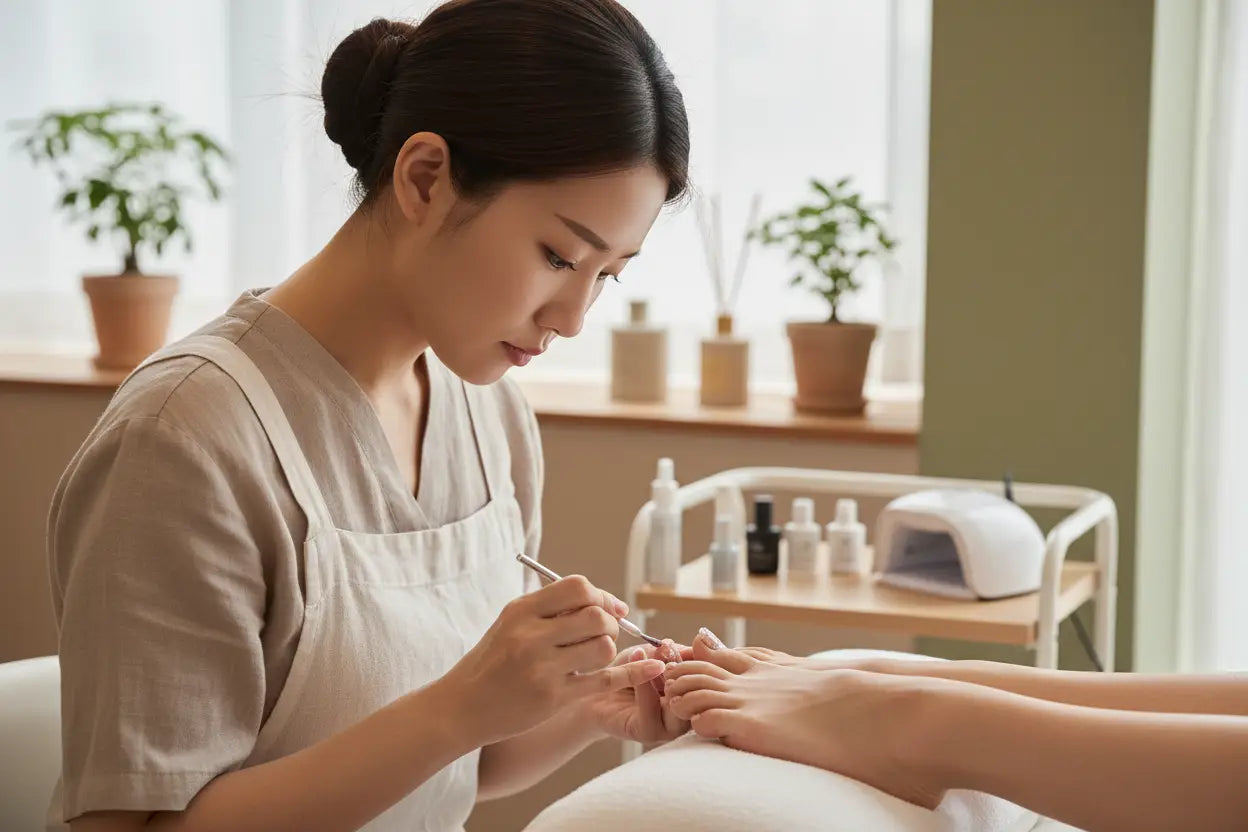
The basic principle is simple: correcting gels add structure to the nail plate. A weakened or strongly curved nail bends under pressure. A properly applied gel layer can reinforce the nail and help it hold a more controlled shape.
That reinforcement changes the force pattern on the nail. Instead of allowing the side edges to collapse inward as easily, the nail plate is better supported. Over time, with maintenance and proper shaping, this can reduce edge pressure and improve how the nail grows forward.
This is why correcting gels are often described as a support tool rather than a cure. They help manage shape and pressure while the nail grows naturally.
Why this works from a scientific point of view
The science behind this is mainly biomechanical. Toenails are made of keratin and behave like small structural plates: they can flex, resist pressure, and respond to repeated force. If a correction method changes how force is distributed across the nail, it can also change the way the nail behaves during growth.
This is the same general reason why nail braces (orthonyxia systems) are used for some ingrown toenails. While gel systems and braces are not identical, they share a common concept: controlled support can help reduce excessive curvature and improve comfort in suitable cases.
In short, correcting gels work because they improve nail shape control and reduce harmful pressure at the nail edges. That is the practical reason many clients feel relief and see better nail appearance over time.
Why technique matters more than the product alone
A correcting gel can only work properly if it is applied with the right technique. This usually includes:
- Preparing the nail surface and sidewalls carefully
- Removing dust, moisture, and oils
- Using the correct base/prep product when required
- Applying the correction gel in a controlled shape
- Curing and refining the final structure
- Maintaining and rebalancing during regrowth
If prep is poor or the gel is applied too thickly, too thinly, or unevenly, the result may not support the nail properly. Good correction is less about “more product” and more about controlled placement and shape.
What correcting gels can do well
- Support inward-curving nails by improving shape stability
- Reduce pressure at the edges in mild cases
- Improve the appearance of uneven or damaged nails
- Help protect fragile nail surfaces while they grow out
- Provide a professional-looking finish with functional benefit
This combination of cosmetic and structural improvement is why these systems are popular in advanced nail care services.
What correcting gels cannot do
It is equally important to understand the limits. Correcting gels do not:
- treat fungal infection,
- replace medical care in severe ingrown nails,
- solve every nail problem in one appointment,
- remove the need for follow-up maintenance.
For example, a yellow or thickened toenail may be caused by trauma, fungus, or both. A cosmetic overlay may improve the appearance temporarily, but it does not diagnose or treat the underlying cause. Proper assessment always comes first.
When to refer to a podiatrist or doctor
Correction gels should not be the first step if the toe shows signs of active inflammation or infection. Refer out if you see:
- redness, swelling, or heat,
- throbbing pain,
- pus or drainage,
- bleeding or open skin,
- repeated severe ingrown nails,
- high-risk clients (diabetes, neuropathy, poor circulation).
In these cases, medical evaluation is the priority. Once the nail is stable and safe to work on, a gel-based correction or cosmetic restoration approach may still be useful later.
Why these systems are popular in Korean nail care
Korean nail brands have developed several step-based systems for problematic nails, including correction and restoration gels used in salon and foot-care settings. These systems are often designed for practical application and visible before/after improvements, while still focusing on controlled, gradual correction.
The strong point of many of these systems is that they fit professional salon workflow: they are technique-based, visually clean, and designed for repeat maintenance rather than one-time “miracle” claims.
Conclusion
Toenail correcting gels work because they provide structural support to the nail plate and help redistribute pressure, which can reduce edge stress and guide the nail into a better shape as it grows. That is the core “how” and “why.”
They are most effective when used in the right cases, with correct prep and application, and with regular maintenance. They are not a replacement for medical care in infected or severe cases, but they can be a very useful support tool for cosmetic restoration and shape management.
For nail professionals and clients, the key is simple: use correcting gels as part of an informed, careful approach — and know when to refer out.
FAQ
Do toenail correcting gels actually straighten the nail?
They do not force the nail straight instantly. They support the nail plate and improve shape control, which can help the nail grow in a better direction over time.
Can correcting gel fix an ingrown toenail permanently?
No. It can help in mild cases by reducing pressure and supporting the nail shape, but severe or recurring ingrown toenails may require podiatry or medical treatment.
Can I use correcting gel on a fungal toenail?
Not as a treatment. If fungal infection is suspected, diagnosis and treatment should come first. A gel overlay may improve appearance but does not treat the infection itself.
How often does a correcting gel need maintenance?
This depends on the product, the nail condition, and growth rate, but regular maintenance is usually needed to keep the shape balanced as the nail grows out.
Is this only cosmetic?
No. It is often cosmetic and functional at the same time. The cosmetic improvement is visible, but the real benefit is often better shape support and reduced edge pressure.
